
Start a Decatur County Property Records Search
Pick your starting point from the clue in hand. Beacon, the county-linked parcel portal, works well for an address, an owner name, or a parcel key. Doxpop indexes the Recorder's recorded documents. Use it when you know a party name, a date, a public ID, or a document type. The Treasurer's tax list searches by district, parcel number, name, tax year, or property address. When only the location is known, Indiana's statewide parcel layer offers a map route.
Keep the parcel number close. It bridges Beacon, Doxpop, and the tax list better than anything else, though older duplicate tax IDs still surface in the Treasurer's system. Read each result with care. A parcel card is not a title opinion, a GIS line is not a survey, and a tax-list name is not a confirmed title holder. The newest recorded deed settles ownership.
- Enter a street address in Beacon or the Treasurer's tax list, using fewer terms if the first query is too narrow.
- Record the APN and distinguish the property address from the owner's mailing address.
- Search Doxpop for the latest deed and note the grantor, grantee, recording date, and instrument identifier.
- Compare the assessment and tax year, then open the statewide parcel layer or relevant plat for location context.
- Ask the Recorder for a copy or certification, or use an APRA request for a public record that is not online.
Meet the Decatur County Property Records Custodians
Three courthouse offices share the job. The Recorder files deeds, mortgages, liens, releases, and plats. The Assessor keeps parcel cards, land and improvement values, deductions, and the ownership roll. The Treasurer collects the bills. Delinquency and tax-sale questions also go to the Treasurer, and all three offices sit at 150 Courthouse Square in Greensburg, open weekdays from 8:00 a.m. to 4:00 p.m.
Decatur County Recorder
150 Courthouse Square, Suite 121
Greensburg, IN 47240
812-663-4681
Decatur County Assessor
150 Courthouse Square, Suite 105
Greensburg, IN 47240
812-663-4868
Decatur County Treasurer
150 Courthouse Square, Suite 138
Greensburg, IN 47240
812-663-4190
Doxpop Opens Decatur County Property Records from 1994
The Recorder offers online recorded documents through Doxpop. Online coverage starts in January 1994. It runs to the present. Party name, recording dates, public ID, and document type all work as search controls, which helps with a recent deed, mortgage, release, lien, or plat. The 1994 start matters for long chains of title. A search that stops there has reached the portal's limit, not the start of ownership history.
The official Doxpop recorded-document screen displays the controls a visitor will see before opening a result.
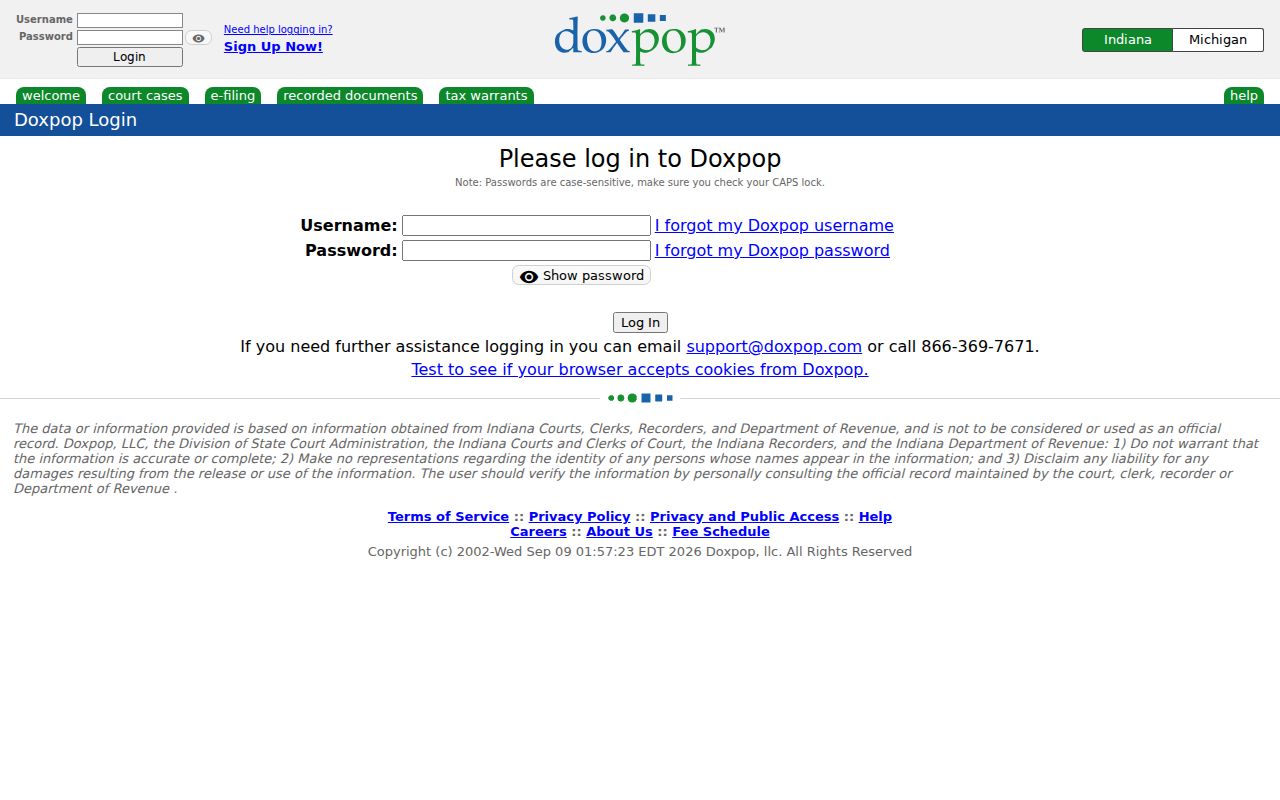
Remember what the index is not. It is a finding aid, not a certified copy. Standard copies up to 11 by 17 inches cost $1 per page, and certification adds $5. Recording fees run $25 for a deed or other instrument and $55 for a mortgage. Those filing fees are separate from search access.
Try party names in more than one form. People appear with and without middle initials. An entity may show up under an abbreviated or former name. Date and document-type filters cut noise. Tighten them too far, though, and the deed you need can vanish from the results. Search broadly first, inspect the returned identifiers, then narrow by the legal description or parcel clues inside the instrument.
Read Decatur County Property Records on a Parcel Card
Beacon links an owner name, an address, a key or parcel identifier, or a tax ID to a full parcel report. Read the identity fields first. Values come second. The owner field is not a mailing address. By contrast, the situs address simply tells you where the land sits. From there, match the APN, legal description, assessment year, land value, improvement value, total value, deductions, and transfer data on the live card.
Parcel vocabulary: an APN identifies the tax parcel. A legal description defines land in recorded terms, assessed value supports taxation, and a plat lays out lots, blocks, streets, and easements.
No fixed schedule governs the owner roll. A recent sale can appear in the Recorder's deed index before the assessor card catches up. Check the newest deed's grantee when timing matters.
Decatur County property records also keep two addresses straight. The roll names a person or entity, while notices go wherever the mailing address points. A mailing address outside Greensburg, or outside Indiana, does not move the parcel. The situs address is a location aid only. It does not prove the owner lives there. Keeping these labels apart prevents a common error when Beacon, the tax list, and a recorded deed disagree.
Decatur County Property Records Use Two Tax Identifiers
The Treasurer's tax list takes Dist#, Parcel #, Name, Tax Year, and Property Address as search terms. Its own instructions carry two warnings. Too much information can restrict the results. Parcels split or combined in the last two years may be easier to find by last name or with Treasurer help. Results can show both the modern APN and a legacy duplicate tax ID. Save both when tracing an older bill or payment.
| Search Field | Best Use | Useful Caution |
|---|---|---|
| Property Address | Finding a known site | Try the street number and core street name first |
| Name | Finding accounts tied to a surname | Helpful after a split or combination |
| Parcel # | Matching an assessor or map result | Keep punctuation shown by the source |
| Tax Year | Separating bill cycles | Assessment year and payable year can differ |
The county's online tax page breaks a bill into its parts. It shows the tax rate and the assessment. It also shows any deduction, spring and fall installments, and payment history side by side. Each line carries the label "Not for Official Use." Only the Treasurer can state an official balance. Only the Treasurer can confirm that a parcel is paid current.
Taxing units get itemized too, rather than one countywide rate. That breakdown tells you where the money goes. It still cannot turn a taxpayer's name into proof of title. When entries conflict, line up the APN, the duplicate tax ID, the situs address, the tax year, and the deed date. That check shows whether two Decatur County property records pages describe the same tract and cycle.
Map Decatur County Property Records with State Geometry
Indiana maintains a statewide parcel-boundary service. It gives Decatur County a map source. This helps whenever a local Beacon screen is out of reach. The layer can help you place an APN, compare adjoining geometry, or orient the legal description in a deed. Remember what the lines are. They are administrative mapping, not monuments set by a licensed surveyor. The Indiana parcel-boundary service publishes the statewide layer and its service details.
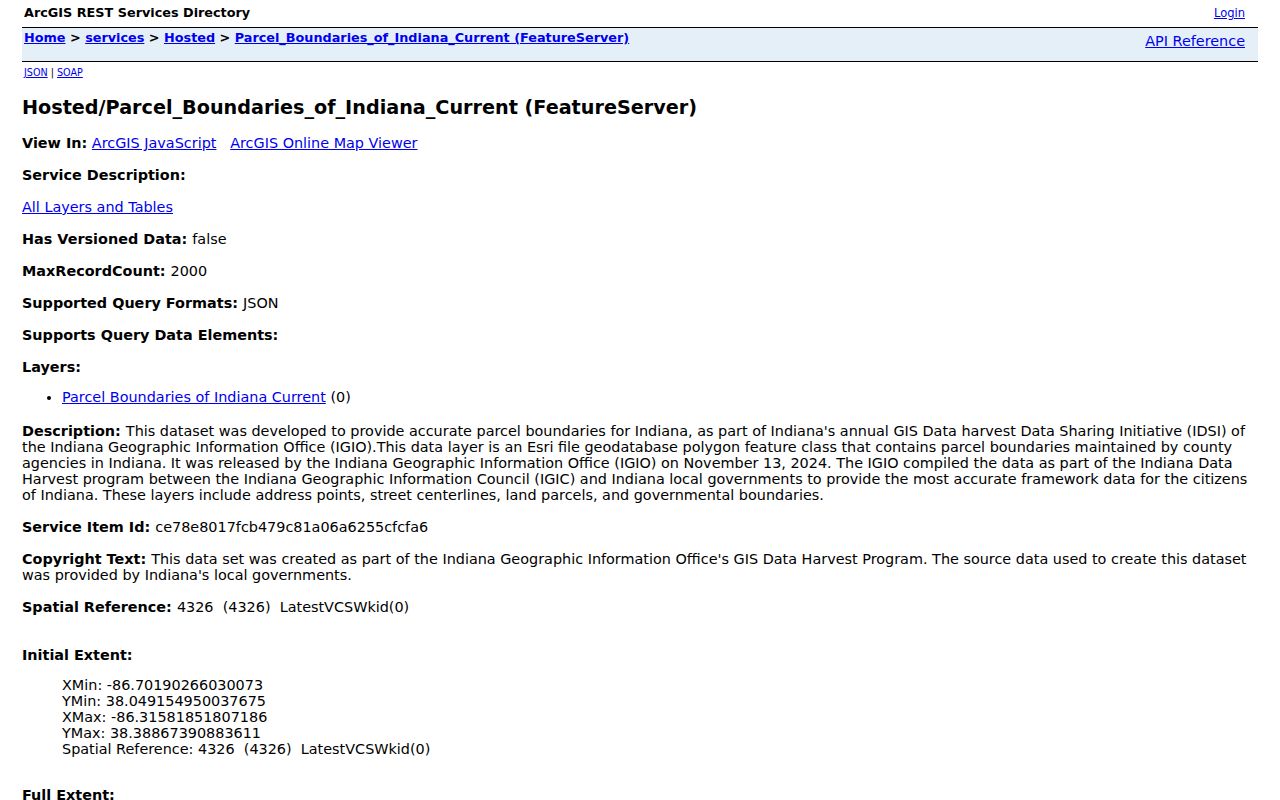
Gather identifiers and context from the map first. Then go back to the Assessor and Recorder. Those offices hold the fields and instruments that actually build the county's administrative record.
A mapped polygon still helps when a street address does not. Select the likely shape. Capture its identifier. Test that identifier against the county systems before trusting it. For Decatur County property records that involve a lot and block, open the recorded plat too. The plat shows the subdivision framework and easements a statewide boundary layer was never designed to interpret.
Compare Decatur County Property Record Types
No single record answers every question about a tract. Recorded instruments prove transfers and encumbrances. Assessor records organize parcels and values, Treasurer records document tax charges and payments, maps supply spatial context, and permit files describe authorized work. Match the question to the custodian before you search.
| Record Type | What It Documents | Kept By | Access |
|---|---|---|---|
| Deeds | Named transfers, legal descriptions, recording references | Recorder | Doxpop from January 1994; office and archives for older material |
| Mortgages and liens | Recorded encumbrances, releases, and related instruments | Recorder | Doxpop index and Recorder copies |
| Assessment and tax | Parcel values, deductions, bills, payments, and delinquency | Assessor and Treasurer | Beacon, tax list, or office |
| Plats and parcels | Lot, block, legal-description, and mapped location context | Recorder and mapping sources | Recorded plats, Beacon, and state parcel layer |
| Permits and zoning | Applications, approvals, and land-use proceedings | Area Plan Commission or city | GeoPermits route, agendas, minutes, and office request |
A named transfer belongs to the recorded instrument, not the tax bill. The amount currently billed belongs to the Treasurer, not the deed. Boundary questions call for the plat, the deed description, physical evidence, and often a survey rather than a drawn parcel line.
Appeal Decatur County Property Records by Notice Date
Indiana Code 6-1.1-4-4.5 governs the Assessor's annual trending. The office describes it as the use of comparable sales. Those come from neighborhood or area sales in the preceding two years. A taxpayer who disputes a value can file Form 130. Useful evidence includes a professional appraisal, adjusted comparable sales, or a valid closing statement. Tax, estate, distress, and exempt sales may not carry the same weight.
The local procedure accepts Form 130 by delivery, mail, fax, or scanned email. The page sets two conditions. A form must arrive within 45 days of the Form 11 mailing date. Emailed appeals must land by 4:00 p.m. on June 15. Notice timing decides which deadline governs. Confirm the year and the notice with the Assessor before relying on any calendar date.
Build the packet around the parcel and assessment year shown in Decatur County property records. Label each comparable, adjustment, appraisal, or closing statement. Explain why each one bears on the disputed value. The Assessor can clarify the filing route. The Property Tax Assessment Board of Appeals handles the county review the official pages describe.
Older Decatur County Property Records Continue on Microfilm
The online deed index stops short of the county's full land history. Indiana State Library finding aids list 36 land items and 36 deed items. The deeds run from 1822 through 1901. The same county microfilm guide holds court, probate, will, marriage, and naturalization collections, which can explain the partitions, estate transfers, and name changes that surface in a chain of title. The State Library's Decatur County maps and atlases guide adds historic map context.
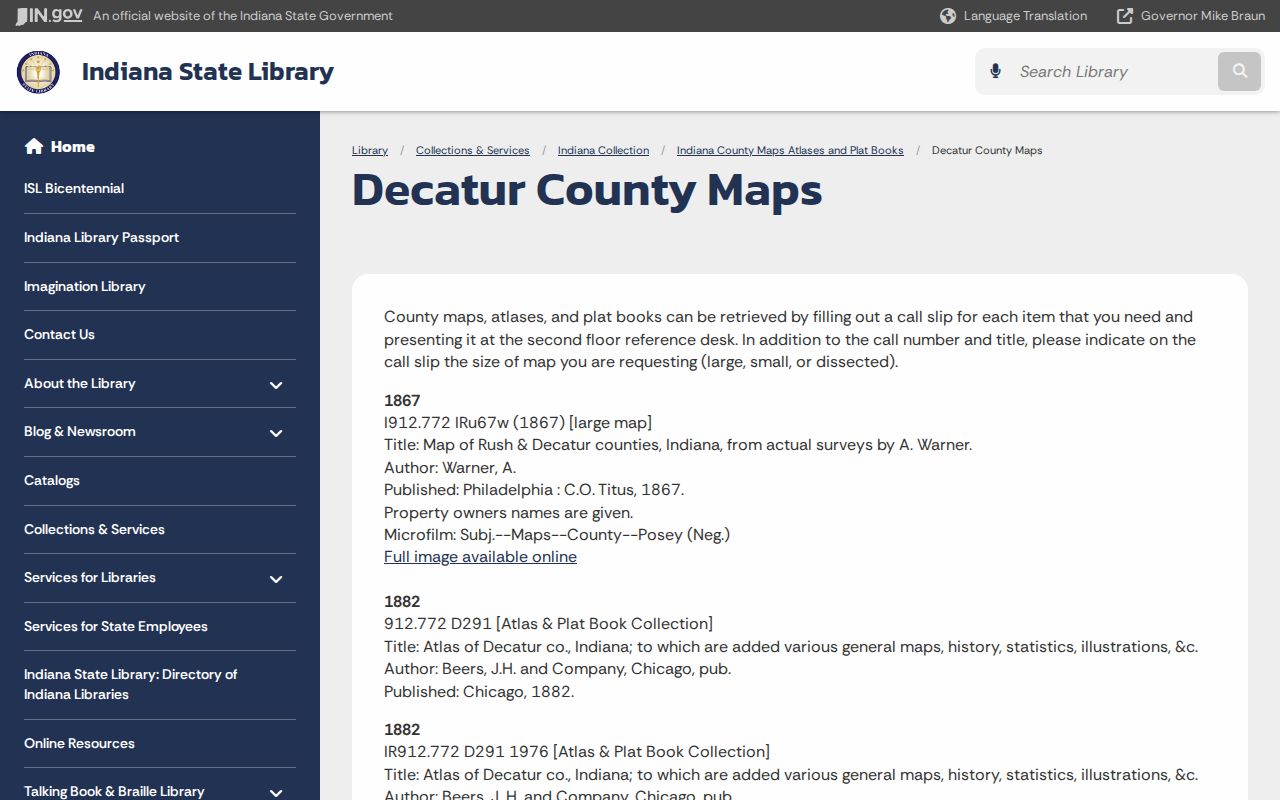
A catalog entry is only a finding aid. It does not promise that every image is online. Ask the repository for the reel, book, page, access method, and copying terms before planning a search of older records.
Decatur County Property Records Cross into Foreclosure Dockets
A foreclosure leaves a trail in two places at once. Doxpop may surface a mortgage, release, lien, or recorded notice. Indiana MyCase may show the public docket filed in Decatur County. MyCase searches by case, citation, cross-reference, party, or attorney. It does not promise a parcel-key index. Start with a party name pulled from the parcel and deed records.
The Clerk keeps the court files and certified material locally. MyCase depth varies by case. Confidential, sealed, expunged, juvenile, adoption, and other protected material stays protected. This holds even when a property dispute sits behind it. Sheriff-sale notices and Treasurer tax-sale records are separate routes. Do not collapse them into one event.
Read the dates in order. A mortgage recording, a foreclosure complaint, a judgment, an order of sale, a sheriff's return, and a later deed are distinct events. They are stored in different Decatur County property records. One event missing from an online screen proves nothing about whether it occurred. Ask the Clerk or Recorder for the public file or instrument whenever the docket summary and the land index leave gaps.
Request Decatur County Property Records through APRA
Indiana's Access to Public Records Act, IC 5-14-3, gives anyone the right to inspect and copy public records during regular business hours. There are limited exceptions. Timing depends on how you ask. A request made in person, by phone, or orally must get a response within 24 hours. A mailed, emailed, or faxed request gets seven calendar days. The custodian can grant or deny it; the Act sets no single production deadline for every request.
Craft the request so it lands with the right office fast. Name the custodian, the parcel number or street address, and the document category. Include a date range that actually matters. Request an electronic copy when one exists. Ask the office to cite the legal basis for any denial. Inspection and search are generally free unless a statute allows a fee. For copies, the Recorder's published prices, $1 per page and $5 for certification, control. Protected details like Social Security numbers can be redacted while the rest of the record is released.
A narrow Decatur County property records request routes far more easily than a demand for "everything." Identify the office, describe the document, give an APN or address. Bound the dates. If that office does not hold it, ask which custodian does. APRA guarantees a response within the window. Actual production time still turns on scope, volume, and staff.
Know the Limits of Decatur County Property Records
Decatur County property records can answer many questions. A recorded deed names the grantee. The files also hold mortgages, liens, assessed values, deductions, tax payments, parcel geometry, plat references, and permit proceedings. What they cannot do is just as important. These records do not guarantee marketable title. They will not settle a boundary dispute, describe a building's condition, or state what a willing buyer would pay. Online data can also lag behind an event recorded by another office. Compare dates carefully and order certified copies whenever a transaction or legal matter rides on the answer.
Lawful use. Use public records for property research, due diligence, estate work, boundary questions, and civic transparency. Never use owner information to stalk, harass, threaten, or harm anyone.