
Decatur County Tax Record Fields
Three offices split the work. The Assessor keeps assessment and deduction data, the Treasurer bills and collects, and the Auditor backs up transfers, duplicate IDs, distributions, lien releases, and tax-sale notices. Read Decatur County property tax records with those roles kept apart.
| Field | What It Shows | Where |
|---|---|---|
| Land value | Assessed amount assigned to land | Assessor / Beacon |
| Improvement value | Assessed amount assigned to improvements | Assessor / Beacon |
| Deductions or exemptions | Tax treatment applied to the parcel | Assessor record |
| Installments and balance | Spring, fall, payment, and amount due | Treasurer detail |
| Taxing units and rates | Allocation among local units | Treasurer detail |
Assessed value is not the bill. Neither is a recorded sale price, since deductions and rates shape what tax is due. Indiana assessment aims at market value-in-use for the property's current use. A deed can state transfer consideration separately.
Search Decatur County Property Tax
The county tax list takes several search keys. Its directions suggest a parcel number, last name, or property address, and they warn that too much input can block a match. For parcels split or combined in the last two years, try a last-name search or contact the Treasurer.
| Field | Input | Use |
|---|---|---|
| Dist# | Text | Known tax district |
| Parcel # | Full APN | Exact parcel |
| Name | Last name advised | Taxpayer-name results |
| Tax Year | Select | Year detail |
| Property Address | Street text; city optional | Known site |
The list runs to 19,783 rows. It is stamped "Not for Official Use!" Columns expose district, APN, a legacy duplicate ID, name and address-like data, and year links. Locate the bill here, then verify against the office record.
Read Decatur County Tax Detail
A 2025 tax-year detail, payable in 2026, separates assessment, deductions, rates, taxing units, installments, and payments. Its lines include county, township, school, library, and solid-waste units. That layout shows how the local record is built. Do not apply its figures to another parcel.
The DLGF Gateway tax-bill lookup serves as a statewide companion. Its entry page appears below.
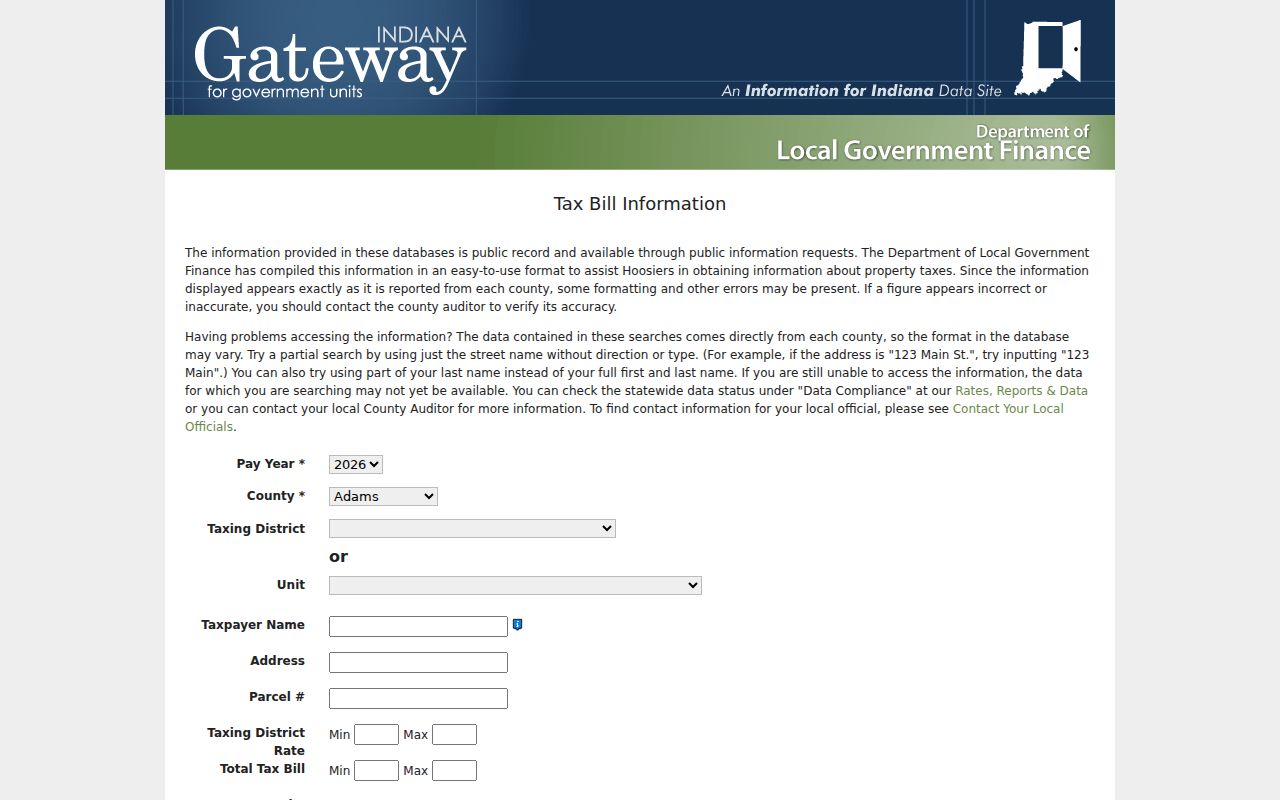
Treat Gateway as a cross-check. Confirm any Decatur County balance or payment with the Treasurer.
Open a Decatur County Tax Bill
Start with the parcel. Finish with the right year and payment status. Copy the full APN and keep it distinct from the duplicate tax ID used for payment. A name in a tax row is not a deed conclusion.
- Search by address, parcel, or last name and select the intended tax year.
- Match district, APN, address, and duplicate ID before opening detail.
- Read spring and fall amounts, payments, balance, rates, and units.
- Compare deductions with Beacon, then ask the Treasurer about delinquency or sale status.
- Assessed value
- The value assigned for property-tax administration.
- Levy or rate
- The charge applied through the taxing-unit calculation.
- Homestead deduction
- A tax benefit, not final proof of current occupancy.
- Tax lien
- A claim tied to unpaid tax whose status needs official confirmation.
Decatur County Annual Trending
Trending works from recent neighborhood sales. Under IC 6-1.1-4-4.5, the Assessor's FAQ explains, annual trending uses comparable neighborhood or area sales from the prior two years. Indiana targets a 100 percent assessment ratio, and the DLGF defines the study ratio as assessed value divided by sale price. One sale does not set every nearby assessment.
Market value-in-use turns on the property's current use. Compare location, class, land, improvements, condition, and year. The county Assessor FAQ is the local source for trending and evidence guidance.
Decatur County Tax Payment Dates
The Treasurer lists spring installments normally due May 10 and fall installments November 10. The dates printed on the bill still control. A mailed statement that never arrives does not erase penalties, so check the current bill.
Payment routes vary. Pay at the office by cash, check, or card; mail a payment; pay online with a duplicate tax ID or last name; or call 1-877-690-3729 with jurisdiction code 2446. Check current convenience charges before using a card.
Decatur County Tax Sale Notices
The Treasurer runs delinquent collection and the annual tax sale. Properties are certified July 1. The sale date is published in a newspaper. The Auditor page carries a 2026 Tax Sale third advertisement.
That notice is a timely lead only. It is not proof that a parcel remains eligible or has sold.
Confirm status with the Auditor and Treasurer. Certification, notice, payment, sale, redemption, tax deed, and later recording are distinct events. Never infer present ownership from an ad.
Appeal Decatur County Assessments
Form 130 starts a local appeal. Decatur County accepts it by drop-off, mail to the Assessor at 150 Courthouse Square, Suite 105, fax to 812-662-6392, or scanned email. The county page says email must arrive by 4:00 p.m. June 15. It also says forms must arrive within 45 days of the Form 11 mailing. Confirm which deadline governs your notice and year.
Protect the appeal window. Confirm the Form 11 date and current filing deadline with the Decatur County Assessor before relying on a general date.
Evidence earns the adjustment. A professional appraisal tops the list. The FAQ ranks adjusted comparable sales and a valid closing statement as strong proof too. Tax, estate, distress, and exempt sales can be weak comparisons. Review can continue through PTABOA and the Indiana Board of Tax Review.
Access Decatur County Tax Records
Beacon and the public list are the quickest entry points. The Assessor handles assessment questions at 812-663-4868. The Treasurer sits in Suite 138 at 150 Courthouse Square. The office is reachable at 812-663-4190 on weekdays from 8:00 a.m. to 4:00 p.m. The Auditor occupies Suite 133 and answers at 812-663-2570.
When bills go missing or you need payment proof, request copies by APN, duplicate ID, and year. Name the copy type you want. Indiana APRA, IC 5-14-3, opens an inspection route subject to exemptions. For what the value figure actually means, see Decatur County property values.
Office and mail access matter when the online list falls short. That happens after a parcel changes or for a historic year. Give staff the full parcel key and the taxpayer name as printed. Add the property address, the tax year, and the pay year. State the exact record sought. Ask what form the reply will take. Will it be an uncertified copy, a payment receipt, a bill duplicate, or a certified office record? Those formats are not interchangeable.
Timing depends on how the request arrives. A phone or in-person APRA request gets a response within 24 hours. One sent by mail, email, or fax draws a response within seven calendar days. The county may acknowledge first and set a reasonable production time. Exempt data can be redacted while separable public content is released. An APRA request cannot force the county to create an appraisal. It cannot recalculate a value, certify clear title, or issue a negative-lien opinion.
Keep each parcel's paperwork together. File the bill, payment confirmation, Form 11, and any Form 130 submission by year. That small record set separates a payment issue from an assessment dispute. It also gives the Treasurer or Assessor a clear reference. That helps when the online row, the mailed notice, and the office record disagree. Resolve the mismatch with whichever office owns that step.
Decatur County Assessment Record Detail
One Decatur Beacon parcel report shows assessment years 2022, 2023, and 2024. It separates land values, improvement values, total values, exemption material, homestead headings, and tax history. It also carries a data-upload timestamp. The owner, mailing address, site address, and sketch do not appear in that older report. Live transfer labels do not appear there either. Read those fields from the current parcel result instead of reconstructing them from old evidence.
Work the fields in a fixed order. Start with the parcel key. Then take the assessment year, land, improvements, and total. After that come deductions or exemptions and the net or taxable amount. Finish with taxing units, rates, installments, payments, and balance. That sequence keeps valuation separate from billing. A homestead entry shows tax treatment and can frame a question for the Assessor. It does not prove occupancy or who holds title today.
Business personal property runs on a different track from real estate. The county FAQ covers businesses, farms, churches, and nonprofits with acquisition cost above $80,000. It names a May 15 filing deadline plus the state POPIN route. Keep those filings out of a house or land tax search. A parcel can carry both real-estate and business-personal-property issues. If it does, ask the Assessor which account and form apply to each.